Dice Probability Player 1 Roles Again Max of 2
In this article we nowadays a set of unusual die and a ii-player game in which you will always have the advantage. You can fifty-fifty teach your opponent how the game works, all the same yet win over again! Finally, we will draw a new game for three players in which you tin potentially beat both opponents — at the same time!
Our two-player game involves 2 dice, simply they're not the ordinary dice we're used to. Instead of displaying the values 1 to six, each die has only two values, distributed as follows:
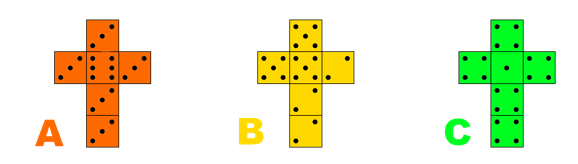
| Dice A: | 3 | three | iii | 3 | 3 | 6 | |
| Die B: | 2 | ii | two | 5 | 5 | 5 | |
| Dice C: | 1 | 4 | 4 | 4 | four | 4 |
This is how the game works: each player picks a die and the two players so roll their respective dice at the same fourth dimension. Whoever gets the highest value wins. Seems fair enough — but is information technology?
It tin can exist shown (see below) that in the long run dice A beats die B (it'll win against B more often than information technology'll lose against B), and that die B beats die C. Then information technology appears A is the potent dice and C is the weak die. And so you lot might wait that, in the long run, dice A beats die C:
If this were the case, and so we'd call the die transitive, as the winning property transfers via dice B in the middle.
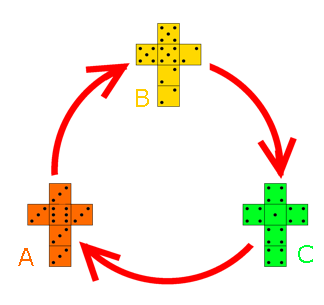
But it is not the instance! In fact, the winning property goes circular in a circle — like in a game of Rock, Paper, Pair of scissors — with die A chirapsia die B, dice B chirapsia die C, and die C beating dice A (in the long run). There is no strong or weak die; the dice are what'southward called non-transitive. But how tin this exist?
Winning chances
Let's come across why die A beats dice B in the long run.
When you roll die A there are two possible outcomes; you lot either roll a 3 or a 6. The probability of rolling a 3 is 5/vi, while the probability of rolling a 6 is one/6. On the other paw, die B can either ringlet a 2 or a 5, each with a probability of 1/two. And then in total, if we curl die A and die B together, we have four possible outcomes, as illustrated in the following tree diagram.

We find the probability of each possible outcome by multiplying the probabilities forth the diagram. For example, the probability of rolling a v with die A and a 2 with die B is 5/six x one/2 = 5/12.
To find the probability that die A wins, add upwards the probabilities of all the outcomes where die A beats dice B. So in this case, the probability die A beats dice B (for which we write P(A>B)) is 5/12+1/12+1/12 = 7/12 — importantly, this is more than one/2. And so in a competition of several games die A is expected to win more often than die B.
In the same way it tin can exist shown that in the long run die B beats dice C, and then remarkably die C beats dice A. (P(B>C)=seven/12 and P(C>A)=25/36.) And so, equally long as your opponent picks first, you will always be able to pick a die with a better chance of winning. The boilerplate winning probability is (7/12 + 7/12 +25/36)/3 = 67/36, which is effectually 62%. It turns out that these iii die requite a maximal prepare in the sense that they maximise the winning probabilities. Just that's not the only surprising thing nearly them.
Double Whammy
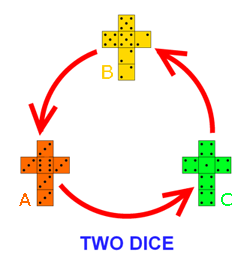
Afterwards a few defeats your opponent might become suspicious, so it's time to come up make clean and explain that you're dealing with non-transitive dice. You can requite your opponent another chance, offer to pick your die beginning, so they should exist able to option a dice with a meliorate gamble of winning. Yous can even offering a change in the game: each of y'all at present rolls 2 of their chosen type of die. Surely, this means that your opponent has just doubled their chances of winning?
Not so! Amazingly, with two dice the social club of the chain flips.
The chain reverses so the circle of victory now becomes a circle of defeat. Now, dice A beats die C, die C beats die B, and die B beats die A, allowing you to win the game once more!
The average winning probability with two dice is around 57%. The total probabilities are:
P(A > C) = 671/1296,
P(C > B) = 85/144,
P(B > A) = 85/144.
A word of warning though: although the probability that die A beats die C is greater than ane/ii, it is a slim victory. In the short term, say less than 20 rolls, the upshot is closer to fifty-fifty, so you will nevertheless need some luck on your side.
Efron dice
The thought of non-transitive dice has been around since the early 1970s. However, the remarkable reversing property is not truthful for all sets of non-transitive dice, for y'all practise need to choice your values carefully. For example, hither is another famous gear up of not-transitive die, invented by the American statistician Brad Efron:
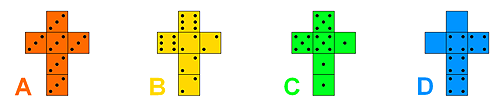
This time the dice use values 0 to 6. Each dice has values:
| Die A: | iii | three | 3 | 3 | 3 | 3 |
| Die B: | ii | 2 | 2 | 2 | 6 | 6 |
| Die C: | ane | ane | 1 | v | v | five |
| Dice D: | 0 | 0 | 4 | 4 | four | 4 |
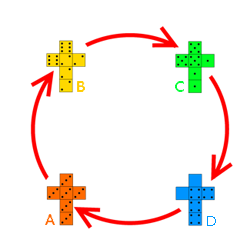
Equally earlier, the die form a circle with die A chirapsia dice B, dice B chirapsia die C, die C beating dice D, and die D beating die A, and they each do so with a probability of 2/3.
We also have two pairs of die opposing each other on the circle. In fact, die B beats die D, only die A and die C each take a 50-l chance of winning, with neither die dominating.
Unfortunately, the player picking dice A will not take a very exciting game, with all the values being the number 3. Also, this concatenation does not brandish the remarkable property of flipping when you double the number of die. The probabilities for 2 sets of Efron dice are:
P(A > D) = v/9,
P(B > A) = 5/9,
P(B > C) = 5/9,
P(C > D) = five/9,
P(B > D) = 11/27,
P(D > B) = 0,
P(B = D) = 16/27 (a depict),
P(A > C) = 1/four,
P(C > A) = 1/four,
P(A = C) = 1/2.
The American investor Warren Buffett is reported to be a fan of not-transitive dice. When he challenged his friend Pecker Gates to a game, with a gear up of Efron dice, Bill became suspicious and insisted Warren choose first. Maybe if Warren had chosen a set with a reversing property he could accept browbeaten Gates — he would simply need to announce if they were playing a one die or 2 dice version of the game after they had both chosen.
3-player games
I wanted to know if in that location is a iii player game, a set of dice where two of your friends may option a die each, yet you lot tin can selection a dice that has a better hazard of chirapsia either opponents — at the same fourth dimension.
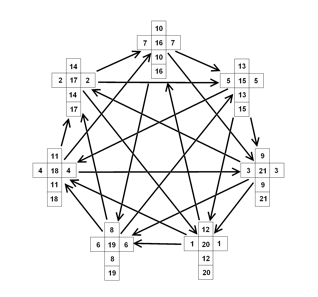
It turns out that there is. The Dutch puzzle inventor Chiliad. Oskar van Deventer came upward with a set up of seven non-transitive dice, with values from 1 to 21. Here ii opponents may each choose a die from the set up of seven, and at that place will be a third dice with a improve chance of winning than either of them. The probabilities are remarkably symmetric with each pointer on the diagram illustrating a probability of five/9.
That'south the probability of beating each individual opponent, but what about the chance of beating both at the same time? If the die were regular off-white dice, with two competing dice having a 50-50 chance of victory (ignoring draws), then the take a chance of beating two opponents at the same time would stand at but over 25%. It isn't exactly 25% because the event of chirapsia one histrion isn't independent of the effect of beating the other. This is because if you curl a high number, y'all're probable to crush both. In the case of van Deventer's dice, the chance of beating both opponents at the aforementioned time is around 39%. So even though you have the advantage against both opponents, beating both players is notwithstanding a challenge.
Is it possible to construct a ready of not-transitive die with a higher take a chance of beating two players at the same time and mayhap even involving less dice? Yes information technology is. I accept devised such a gear up below.
Grime dice
Here is a set of v non-transitive dice:

These dice apply values from 0 to 9, as follows:
| Dice A: | 4 | 4 | 4 | 4 | iv | nine |
| Die B: | 3 | 3 | iii | iii | 8 | 8 |
| Die C: | 2 | two | two | seven | 7 | 7 |
| Die D: | 1 | 1 | vi | 6 | half-dozen | 6 |
| Die Due east: | 0 | 5 | 5 | 5 | v | 5 |
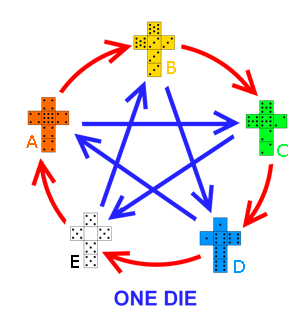
As with other sets of dice we have seen, we have a chain: A>B>C>D>E>A.
However, inside that we also have a second chain: A>C>E>B>D>A.
The average winning probability for 1 die is 64.7%. The exact probabilities are
P(A > B) = 13/18,
P(B > C) = two/3,
P(C > D) = 2/three,
P(D > E) = 13/18,
P(E > A) = 25/36,
P(A > C) = 7/12,
P(B > D) = 5/ix,
P(C > East) = 7/12,
P(D > A) = 13/18,
P(East > B) = v/9.
This means that given two dice, you cannot always find a third die that beats both. For example, this is the case when the ii given dice are C and Eastward.
If our original set of iii non-transitive dice was similar a game of Rock, Paper, Scissors, this diagram is closer to the related, but more than extreme, not-transitive game Stone, Paper, Scissors, Lizard, Spock
With two dice the first chain stays the aforementioned. Just the second chain now flips, and then A>D>B>E>C>A.
The average winning probability for ii dice is 59.2%. The verbal probabilities are
P(A > B) = 7/12,
P(B > C) = 5/9,
P(C > D) = 5/9,
P(D > East) = 7/12,
P(Due east > A) = 625/1296 (a slim defeat, just in the short term the effect is 50-50),
P(A > D) = 56/81,
P(B > Eastward) = 56/81,
P(C > A) = 85/144,
P(D > B) = 16/27,
P(E > C) = 85/144.
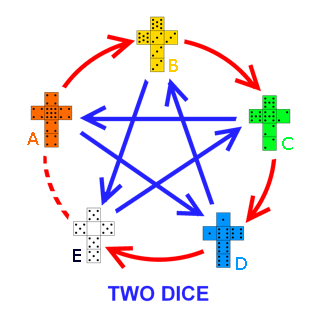
Overall, the average winning probability is 61.9%. This gives us a way of playing the game confronting two opponents: invite each actor to pick 1 of the dice, but do non volunteer the rules of the game at this point. When the two other players accept made their choice, you may now brand your choice, including whether y'all and your opponents will be playing the one die or two dice version of the game. Equally earlier we play a game of say 10 rolls and, no matter which die your opponents cull, there volition always exist a die with a meliorate chance of beating each player.
For example, if one opponent chooses die B and the other opponent chooses die C, then you should pick die A and play the one die version of the game. Then, according to the first diagram above, you will have a improve chance of winning than either individual opponent.
On the other paw, if 1 opponent chooses die C and the other opponent chooses die Eastward, then you should pick dice B and play the 2 dice version of the game. Then, co-ordinate to the second diagram to the right, you can expect to beat each opponent again.
A gambling game
Merely, can nosotros expect to beat the two other players at the same fourth dimension? Well, we have certainly improved the odds, with the average probability of beating both opponents now standing at around 44%. That's a five% improvement over van Deventer 'due south dice, and a 19% improvement over off-white die.
But if the odds of chirapsia two players isn't over 50% how tin can we win? Consider the following gambling game:
Challenge two friends to a game in which you will play both of them at the aforementioned time. If yous lose, you will give your opponent £1. If yous win, your opponent gives y'all £one. So if y'all beat both players at the same time, you lot win £2; if you lose to both players, you lose £two; and if y'all beat i role player but not the other so your net loss is zilch. You and your friends make up one's mind to play a game of 100 rolls.
If the die were fair, then each player would expect to win cipher, since each player would exist expected to win half the time and lose half the fourth dimension.
With van Deventer 'south dice, you should expect to shell both players 39% of the time, and lose to both players 28% of the fourth dimension, which volition give you a cyberspace turn a profit of £22.
Simply with Grime die, yous should expect to beat out both players 43.8% of the time, but only lose to both players 22.7% of the time, giving y'all an boilerplate net profit closer to £42! (And maybe the loss of two friends).
This set is the best ready of five non-transitive dice with these properties that I have found.
I invite you to try out these games yourself. They are easy to make by either writing on blank die, or modifying some old dice. Try them out on your friends and enjoy your successes and failures!
Here's a further challenge
For the very keen, hither's a set to endeavor that uses mathematical constants:
| Die A: | 1 | 1 | 1 | 1 | i | π |
| Dice B: | Φ | Φ | Φ | e | eastward | e |
| Die C: | 0 | φ | φ | φ | φ | φ |
where e is Euler's number (2.718...), φ is the aureate ratio (1.618...) and Φ is the conjugate of the aureate ratio (0.618...). Practice these dice form a non-transitive set? What about with 2 dice, does the order opposite every bit before?
Further reading
Find out more near non-transitive games in the Plus manufactures Winning odds and Permit 'em whorl.
About the author

James Grime is a lecturer and public speaker on mathematics, and can be mostly found touring the land on behalf of the Millennium Mathematics Projection carting his trusty Enigma Machine. If you'd like James and the automobile to visit your school, visit the Enigma website.
Source: https://plus.maths.org/content/non-transitiv-dice
0 Response to "Dice Probability Player 1 Roles Again Max of 2"
إرسال تعليق